Dec 26, 2025
Newsletter
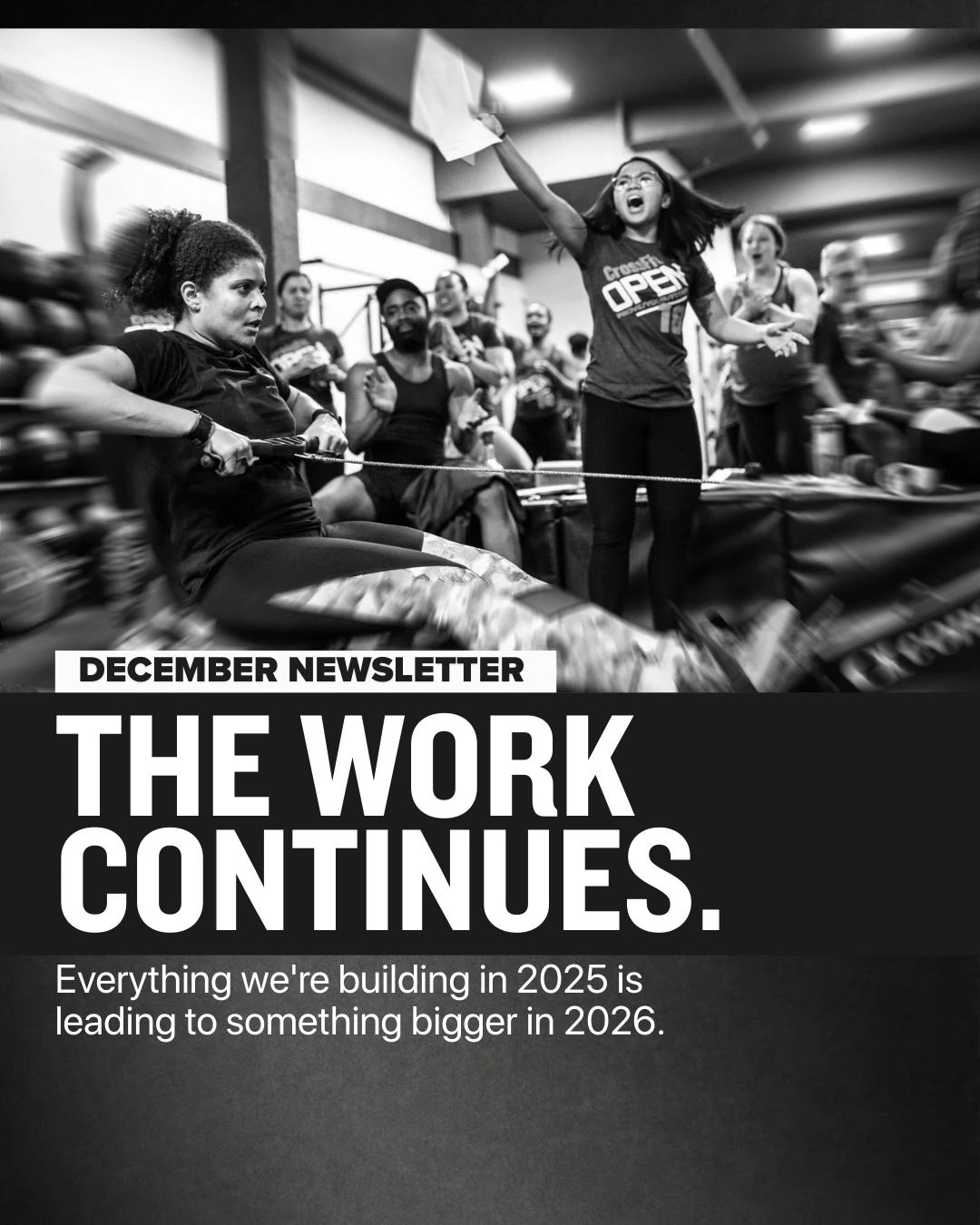
December Newsletter
Everything we are building in 2025 is leading to something bigger in 2026.
As we head into the final stretch of the year, we wanted to pause and share a bit of what we’ve been working on and where we’re going next.
Everything we do at the CrossFit Medical Society is in service of the same belief that brought us all here in the first place: CrossFit works. The methodology works. The affiliate model works. And when it’s supported with the right education, resources, and healthcare partnerships, it becomes one of the most powerful tools for improving health at scale. This work is not separate from CrossFit. It exists because of it, and alongside it.
In this month’s newsletter, we’re sharing the next article from Defining Fitness Flexibility, along with an excerpt from the Health Integration Guide that unpacks public health. Education remains the backbone of CFMS. Not academic for the sake of it, but practical, usable, and grounded in the reality of the affiliate floor and the communities you serve every day.
We’re also excited to share that the next Health Integration Summit will be in Boston on April 25 and 26. Registration opens in January, but you can pre-register here. Our intent with these summits is to highlight what’s possible when affiliate owners, coaches, and healthcare providers come together around a shared mission. Boston will be no different.
While the past few months may have felt quieter publicly, they’ve been anything but behind the scenes. We’ve been deep in the work so that 2026 can be a true inflection point for affiliates who want to lead in health, not just fitness.
One of the ways that’s coming to life is through the continued expansion of the CFMS Biomarker Hub. We’re adding new lab panels, including Omega-3 Index testing, micronutrient panels, and microbiome testing. To make this accessible across the country, we’ve partnered with a national mobile phlebotomy company that can support in-affiliate lab draws nationwide. This means affiliates can offer real diagnostic tools in a way that’s streamlined, compliant, and aligned with how CrossFit communities already operate. We're also making it easier for affiliates to connect their members with providers for lab reviews.
This is about reinforcing what affiliates already are: trusted centers of health, connection, and accountability in their communities.
We’re also thrilled to share that CFMS is going mobile. Our app launches in January, alongside a completely refreshed CFMS website. Yes, the app will make it easier to access education, earn CME and CEU, read journal articles, order labs, and log into your biomarker visualizer. But more than that, it will house an updated CFMS provider database and a space for all of us to connect with one another.
This is not about building another platform for noise. It’s about building infrastructure for community. We need to be able to find each other, learn from each other, and work together as we shape the future of healthcare from the ground up, starting in affiliates.
CommunityCare continues to grow steadily, with enrollment increasing by 15% or more each month. We’ve just onboarded a second wave of affiliate owners who have been part of CommunityCare throughout 2025, and they’re now offering it to their members. If you’re already part of CommunityCare as an owner and want to explore how to expand access in your gym, we’d love to talk.
With the holidays approaching and a lot of meaningful work happening behind the scenes, Grand Rounds will return in January. We’re looking forward to starting the new year together, grounded in conversation, learning, and shared purpose.
Thank you for being part of this community. Thank you for believing in the affiliate model. And thank you for continuing to do the work, day in and day out, that makes CrossFit what it is.
From all of us at the CrossFit Medical Society, we wish you and your families a happy, healthy holiday season.
Excerpt From the Health Integration Guide’s Course on Public Health:
Why Public Health Matters for Coaches
CrossFit coaches may not think of themselves as part of the public health system—but they are. Every hour, inside thousands of affiliates around the world, coaches are doing what public health was designed to do: prevent disease, improve function, and enhance quality of life through education and behavior change.
The mission of CrossFit—to improve health through fitness—is a public health statement. It is measurable, observable, and repeatable at scale. When you take an individual who’s sedentary, overweight, or metabolically unfit and guide them through consistent, functional movement and sound nutrition, you are reducing population-level disease risk. When you do that for hundreds of people in your community every year, you are running a public health intervention.
In The Community Cure, James Maskell writes that the future of health is social. Isolation, he explains, is the new smoking—driving inflammation, stress, and premature death. Health, conversely, is contagious. Communities built around shared purpose, accountability, and connection heal faster and stay healthier. If that sounds familiar, it’s because it’s the same foundation upon which CrossFit was built.
Public health isn’t an institution or a department. Instead, it’s a practice of caring for people before they get sick. It’s the quiet power of prevention. And the modern affiliate, when understood through that lens, is one of the most effective and scalable public health tools on the planet.
Application Note:
At your next coach meeting, reframe your role: You’re not just coaching workouts. You’re delivering a preventive health service. Discuss one example from your member base that shows how consistent training has changed a health outcome (e.g., lowered A1C, reduced medication, improved mobility).
What Is Public Health?
Public health is often misunderstood as bureaucracy, something done by government agencies with charts and funding. In truth, it’s the science and art of preventing disease, prolonging life, and promoting health through organized community effort.
Where medicine focuses on the individual, public health looks at the group. It asks: How can we design environments and systems that make the healthy choice the easy choice?
At its core, public health is about prevention, population health, and behavior change at scale. It addresses the upstream causes of sickness: poor diet, physical inactivity, social isolation, and environmental stressors. The solutions are rarely clinical. Instead they are cultural.
In Community-Centered Public Health, authors Akintobi and Miles-Richardson emphasize that community engagement is not an accessory to good public health, it’s the foundation. Interventions only work when they reflect the realities, strengths, and values of the people they serve. This is what CrossFit affiliates already do instinctively. Each gym is locally owned, embedded in its community, and responsive to its members. Coaches meet people where they are and create environments where health behaviors become the social norm.
Similarly, The Connected Community by Corman Russell and John McKnight reminds us that “health is not produced by systems but by relationships.” True health arises when people know each other, support each other, and take responsibility for each other’s well-being. A CrossFit class is precisely that, a microcosm of connected human health. When affiliates run nutrition challenges, celebrate consistency, and rally around members recovering from injury or illness, they’re not only changing individuals, they’re shifting the cultural expectation of what “normal” health looks like.
This is what public health looks like when it works: local, relational, participatory, and measurable.
Application Note:
At your next staff development session, define “public health” in your own words. Then list three ways your affiliate already contributes to population health (e.g., improving physical activity levels, reducing social isolation, building nutrition literacy). You’ll see that you’re already practicing public health daily—just without the jargon.
A note on CommunityCare
If you’ve been meaning to learn more about CommunityCare and whether it’s the right fit for you or your affiliate, it’s not too late. This time of year, “open enrollment” usually means added stress. During what’s supposed to be the jolliest part of the year, people are forced to decipher bronze, silver, or gold plans and hope they’re choosing the option that will cost them the least when something actually happens.
CommunityCare works differently.
We don’t have an open enrollment window. CommunityCare is always open. And more importantly, we’re always here to help you understand how it works, answer your questions, and decide if it aligns with your values, your family, or your community. No pressure. Just clarity, conversation, and support.
If you’re curious, reach out. We’re happy to walk you through it.
Have something to say? Email us at
‹ Previous
Next ›
Subscribe to our newsletter

Sign up with your email address to receive news and updates.
