Jan 6, 2026
Journal
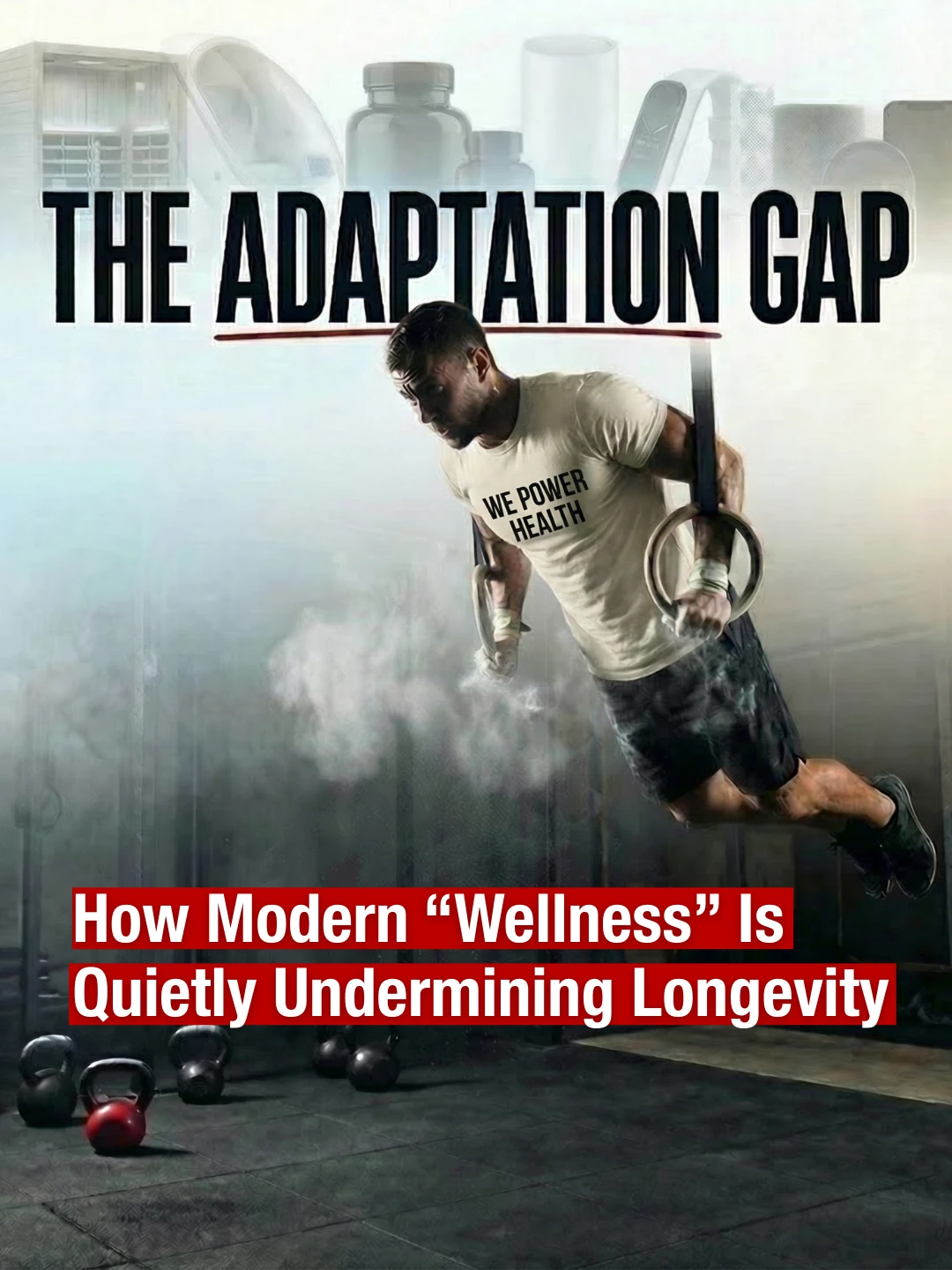
The Adaptation Gap: How Modern “Wellness” is Quietly Undermining Longevity
Modern wellness has become a commoditized spectacle—offering comfort, aesthetics, and passive solutions while the biological foundations of health quietly deteriorate. CrossFit stands as a counterculture by refusing to sell ease, instead building longevity through the one thing wellness avoids: adaptation earned through deliberate, sustained effort.
Written by Dr. Janette Watkins and Jenn Pishko, MS
We are living in the most comfortable moment in human history, and that comfort is quietly costing us our ability to adapt.
Nearly every modern system is designed to make life easier. Food arrives instantly. Climate is controlled. Movement is optional. Effort is outsourced. Discomfort is framed as unnecessary, even dangerous. Health, once forged through daily interaction with the physical world, has been repackaged into something that can be optimized, purchased, and consumed.
This is commoditization.
Commoditization is the process of stripping something complex and human of its context and turning it into a standardized product. Its goal is not to increase the value of the individual, but to increase what can be extracted from them. Attention. Money. Dependence. The more passive the consumer, the more scalable the solution. The more reliant the person becomes on external tools, the less capable they are of producing the thing themselves.
When applied to human health, commoditization does not elevate capacity. It reduces it.
We are now entering an era where wellness itself has become a spectacle. What once centered on simple, evidence-based behaviors like lifting, moving, sleeping well, and eating whole foods has transformed into a high gloss ecosystem of products promising effortless health. Infrared saunas, red light devices, recovery pods, high priced wearables, and bio-optimized routines dominate social spaces and market shelves. Wellness has become a curated aesthetic more than a physiological pursuit. It offers the image of vitality without requiring the work that sustains it.
Beneath this polished surface, something essential is eroding. Despite record spending on wellness, foundational measures of human capacity are declining. Physical strength is down. Cardiovascular fitness is worsening. Metabolic dysfunction is rising, even among people who identify as healthy. Grip strength is falling [7]. VO₂max continues its steady population level decline [6]. The systems that once made human beings resilient are weakening in plain sight [8].
The paradox is hard to ignore. People are more invested in wellness than ever, yet becoming biologically less well. The issue is not a lack of concern for health. It is that modern wellness encourages people to consume health rather than produce it. Recovery is sold without strain. Balance is marketed without effort. Longevity is promised without the challenges that make longevity possible.
This moment represents more than a cultural trend. It reveals a growing gap between what the human body requires to age well and what the wellness economy is offering. As comfort replaces challenge, the adaptive mechanisms that sustain long term health quietly deteriorate. Bones lose their signal to strengthen. Muscles no longer receive a reason to grow. Cardiovascular systems are spared the stress that once kept them robust. Mitochondria shrink. Resilience fades. Humans will always seek what feels easier. That instinct once helped us survive freezing climates, food scarcity, and constant environmental threat. Innovation reduced existential danger and preserved life. But modern innovation has crossed a critical line. We are no longer removing threats to survival. We are removing the very stressors that shaped our biology.
This is why so much of what is sold as wellness today feels hollow. It acknowledges that the reactive medical model is broken. It borrows the language of longevity and healthspan. But it avoids the one thing humans need most to reverse decline: adaptation, earned through discomfort. And this is precisely why CrossFit remains culturally inconvenient. It refuses to participate in the commoditization of health. It does not offer ease. It does not promise comfort. It does not outsource effort. Instead, it insists on something deeply countercultural in a world obsessed with convenience.
Health is not something you buy. It is something you adapt into.
And adaptation has never been comfortable.
Longevity Is an Adaptive Process—Not a Wellness Purchase
Human longevity is built on adaptation. The body evolved under physical and environmental demands that required constant physiological adjustment. Bone strengthens when loaded—an adaptation confirmed repeatedly in osteogenic research [1]. Muscle hypertrophies in response to progressive resistance [2]. Cardiovascular capacity improves only when the heart and lungs are stressed above baseline [3]. Metabolic health is shaped by fluctuating energy demands, not steady comfort [4]. Even cognition improves through physical and cognitive complexity [5].
These adaptations are not optional features; they are the biological drivers of long-term health. They determine independence, disease risk, cardiovascular aging, and the ability to recover from illness or injury. And they are triggered only when the body is challenged. No wearable, supplement, cold plunge, or passive recovery technology can activate these systems. They are effort-dependent.
Modern wellness culture, however, increasingly frames discomfort as dangerous and effort as outdated. “Low-impact” is marketed as universally superior, though impact is essential to maintaining bone density. “Gentle movement” becomes synonymous with fitness, even as research shows that intensity is critical for preserving VO₂max—a marker of longevity more predictive than cholesterol or blood pressure. Recovery tools promise benefits that used to arise naturally from consistent physical work.
This cultural shift toward ease is not physiologically neutral—it is biologically regressive. When stressors disappear, the systems designed to respond to them weaken. Bones remodel less. Muscles atrophy. Cardiovascular capacity shrinks. Mitochondria diminish. Cognitive resilience wanes. The mechanisms that once helped human beings thrive deteriorate when left unstimulated.
Longevity cannot be purchased. It must be practiced. And the practice requires doing things the modern wellness landscape has systematically removed.
The Glitz of Wellness and the Decline of Adaptation
As wellness becomes ever more aesthetic and product-driven, its foundational message continues drifting toward comfort. Wearables track behavior but do not shape it. Recovery tools soothe but do not strengthen. Detox products promise benefits without metabolic demand. Influencer-led routines emphasize ease and self-pampering rather than growth. The entire ecosystem reinforces a narrative that health can be maintained without strain.
This is biologically false. And the consequences are measurable. Studies show that physical activity levels are declining despite increased awareness of fitness [8]. Cardiovascular fitness is worsening across age groups [6]. Strength—a predictor of mortality—is dropping in younger adults at alarming rates [7]. The adaptive systems that maintain human longevity are fading, not from neglect, but from misdirection.
What makes this trend more troubling is that people believe they are doing the right things. They invest in expensive wellness tools believing they are “supporting longevity,” when in reality, many are avoiding the stressors that longevity requires. It is not apathy—it is misinformed effort.
The irony is profound: as wellness products become more advanced, society becomes less adapted. The more people chase optimization without strain, the more fragile they become.
If longevity depends on adaptation, the wellness machine is pushing society in the opposite direction.
CrossFit as Counterculture: Adaptation Over Aesthetics
CrossFit stands almost alone within modern culture as a model for health built explicitly around adaptation. While wellness trends increasingly sell comfort, CrossFit insists on effort. It requires work, progression, community accountability, and deliberate exposure to stress—all of which provoke the biological adaptations that support long-term health.
This is not philosophy; it is physiology. CrossFit’s foundational practices—lifting heavy loads, training at varied intensities, practicing complex movements, and performing skill-based tasks—align directly with empirical research on what enhances longevity. Strength training improves mortality risk more than nearly any other lifestyle behavior [2]. High-intensity training elevates VO₂max, arguably the single strongest predictor of lifespan [3]. Complex movement enhances neuromuscular and cognitive function [5]. Even the psychological demands of CrossFit—perseverance, effort tolerance, learning to push through controlled discomfort—map onto resilience studies showing that moderate stress exposure builds long-term adaptability [9].
What ultimately makes this model powerful is not just the methodology, but the affiliate itself.
An affiliate is not a place to consume health. It is a place to practice it. It is a stable, trust based, relationship driven environment where health behaviors are repeated, observed, and reinforced over time. When societal norms increasingly treat health as a product, this alone makes the affiliate an outlier.
As affiliates evolve into health hubs, they are not replacing the work. They are protecting it from being commoditized. A health hub does not lower the demand for effort. It keeps effort visible and unavoidable. What changes is the surrounding structure. Education restores understanding so health is not reduced to transactions. Preventive diagnostics provide feedback without turning the individual into a data point to be monetized. Coaching connects daily decisions to long term capacity. Clinicians who embrace the methodology support adaptation instead of overriding it. Community supported healthcare models reinforce responsibility and participation rather than dependence and extraction.
The work remains central. It simply becomes supported instead of exploited.
When the components required for real health exist inside the walls of the affiliate, health stops being something people shop for. It stops being fragmented across apps, appointments, and subscriptions or the glitz and glamor of wellness. Fitness, education, accountability, and care are no longer commodities, but become integrated practices sustained by real relationships. Affiliates are the opposite of commoditization. Nothing is standardized for mass consumption. Nothing is optimized for passivity. Value is not extracted from the individual. Capacity is built within them. In a system that profits from making people easier to manage and easier to sell to, the affiliate health hub does something quietly radical. It refuses to turn human health into a product.
CrossFit asks for what the body actually requires. It does not promise effort-free health. It promises adaptation through deliberate exposure to stress, progression, and accountability. This is the core of the methodology, and it is why it has endured while wellness trends come and go.
It is not glamorous. It is not curated. It is not aesthetic. It is built on simple principles applied consistently over time. Lift heavy things. Move with intensity and purpose. Learn complex skills. Recover through work, not avoidance. These practices speak the body’s native language: stress, adaptation, and increased capacity.
As affiliates evolve into health hubs, this work is not replaced. It is reinforced. The methodology remains the foundation, while education, diagnostics, coaching, and aligned healthcare support the behaviors that make adaptation possible. Health is no longer fragmented or outsourced. It is practiced where effort already lives, inside a community built for consistency and accountability.
In a culture drifting toward fragility and commoditized solutions, CrossFit affiliates that step fully into this role offer something rare. A system that does not sell health, but builds it. A model that protects human resilience by refusing to remove the work required to sustain it.
References
Nikander, R., Sievänen, H., Heinonen, A., Daly, R. M., Uusi-Rasi, K., & Kannus, P. (2010). Targeted exercise against osteoporosis: A systematic review and meta-analysis. BMC Medicine, 8(1), 47. https://doi.org/10.1186/1741-7015-8-47
Phillips, S. M., & Winett, R. A. (2010). Uncomplicated resistance training and health-related outcomes: Evidence for a public health mandate. Current Sports Medicine Reports, 9(4), 208–213. https://doi.org/10.1249/JSR.0b013e3181e7da73
Blair, S. N., Kampert, J. B., Kohl, H. W. III, Barlow, C. E., Macera, C. A., Paffenbarger, R. S., & Gibbons, L. W. (1996). Influences of cardiorespiratory fitness and other precursors on cardiovascular disease and all-cause mortality. JAMA, 276(3), 205–210. https://doi.org/10.1001/jama.1996.03540030039029
Hawley, J. A., & Holloszy, J. O. (2009). Exercise: It’s the real thing! Nutrition Reviews, 67(3), 172–178. https://doi.org/10.1111/j.1753-4887.2009.00186.x
Voelcker-Rehage, C., & Niemann, C. (2013). Structural and functional brain changes related to different types of physical activity across the lifespan. Neuroscience & Biobehavioral Reviews, 37(9), 2268–2295. https://doi.org/10.1016/j.neubiorev.2013.01.028
Kaminsky, L. A., Arena, R., & Myers, J. (2015). Reference standards for cardiorespiratory fitness: Data from the FRIEND registry. Mayo Clinic Proceedings, 90(11), 1515–1523. https://doi.org/10.1016/j.mayocp.2015.07.026
Peterson, M. D., Duchowny, K., Meng, Q., Wang, Y., Chen, X., Hale, L., & Breslin, G. (2021). Trends in grip strength among older adults in the United States: 2011–2018. Journal of Gerontology: Series A, 76(5), 888–893.https://doi.org/10.1016/j.ssmph.2019.100456
Shook, R. P., Hand, G. A., Drenowatz, C., Hebert, J. R., Paluch, A. E., Blundell, J. E., Hill, J. O., Katzmarzyk, P. T., Church, T. S., & Blair, S. N. (2015). Low levels of physical activity are associated with dysregulation of energy intake and fat mass gain over 1 year. The American journal of clinical nutrition, 102(6), 1332–1338. https://doi.org/10.3945/ajcn.115.115360
Seery, M. D., Holman, E. A., & Silver, R. C. (2010). Whatever doesn't kill us: Cumulative lifetime adversity, vulnerability, and resilience. Journal of Personality and Social Psychology, 99(6), 1025–1041. https://doi.org/10.1037/a0021344
Have something to say? Email us at
‹ Previous
Subscribe to our newsletter

Sign up with your email address to receive news and updates.
