Jan 23, 2026
Newsletter
January Newsletter
Operational updates. Real momentum. Clear purpose. This month’s newsletter is more operational than inspirational, but clarity matters. There is a lot moving inside the CrossFit Medical Society ecosystem, and we want to make sure the details stay clear as we continue to build. That said, we are incredibly excited about these updates and grateful to be moving this work forward with such an aligned community.
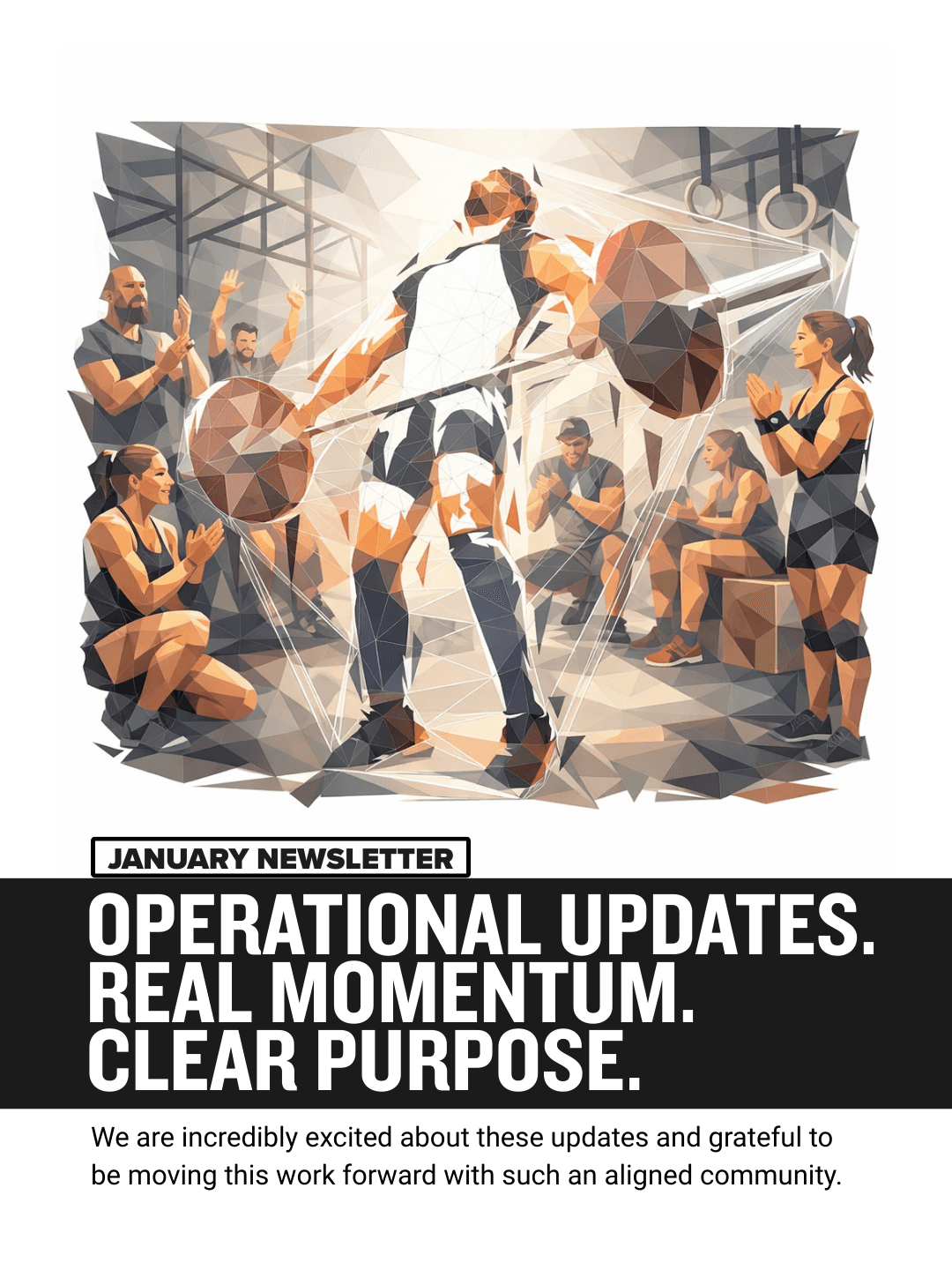
Operational updates. Real momentum. Clear purpose.
This month’s newsletter is more operational than inspirational, but clarity matters. There is a lot moving inside the CrossFit Medical Society ecosystem, and we want to make sure the details stay clear as we continue to build.
That said, we are incredibly excited about these updates and grateful to be moving this work forward with such an aligned community.
Website Relaunch: Now Live
Last week we officially launched the new CrossFit Medical Society website.
You’ll still find:
Access to CommunityCare for information and enrollment links
The Biomarker Hub for easy lab ordering
Newsletters and journal articles
CFMS swag
Provider Directories
The website serves as the foundation of the ecosystem—but it’s only the starting point.
CFMS Mobile App: Launching Soon
Launching in the coming weeks: the CFMS mobile app.
The app will:
Put all website content at your fingertips
Serve as our new CME/CEU platform (fully mobile-friendly)
Merge provider directories into one easy-to-search experience
Function as a community-based communication platform
If you are:
A CommunityCare affiliate
Attending a Health Integration Summit
A healthcare provider
Part of the CME/CEU courses
…you’ll have access to dedicated community spaces designed to foster organic connection and streamline communication.
As each component rolls out, we’ll continue to share clear updates and instructions on how to join.
CommunityCare Momentum
CommunityCare has seen significant growth over the past few months, and we continue to hear how impactful this platform has been for affiliate owners, coaches, and their communities.
More affiliates are being onboarded to offer CommunityCare directly to their members.
If you are currently enrolled in CommunityCare and interested in learning more about how to engage, integrate, or support this offering, please reach out—we’d love to connect.
Featured Article: The Adaptation Gap
Last month, we released The Adaptation Gap, an article exploring the growing disconnect between what humans are biologically designed to adapt to and the modern environments we now inhabit.
A core theme of the article is simple but uncomfortable:
You cannot buy what must be earned.
Below is a brief excerpt from the piece:
Nearly every modern system is designed to make life easier. Food arrives instantly. Climate is controlled. Movement is optional. Effort is outsourced. Discomfort is framed as unnecessary, even dangerous. Health, once forged through daily interaction with the physical world, has been repackaged into something that can be optimized, purchased, and consumed.
This is commoditization.
When applied to human health, commoditization does not elevate capacity. It reduces it.
Despite record spending on wellness, foundational measures of human capacity are declining. Strength is down. Cardiovascular fitness is worsening. Metabolic dysfunction is rising. VO₂max continues its population-level decline.
Modern wellness encourages people to consume health rather than produce it.
Health is not something you buy. It is something you adapt into.
And adaptation has never been comfortable.
The full article is linked, and we encourage you to read it, share it, and discuss it within your communities.
Tying into ‘Why the Open Matters’
Last week, we saw a social post that simply said:
“Only CrossFit is CrossFit.”
It was simple and it felt deeply fitting.
CrossFit is not just a workout style or a collection of WODs. It is a scientifically grounded methodology that demands balance across strength, endurance, power, skill, and intensity over time. It creates the conditions required for true physiological adaptation. This is something most modern fitness and wellness models fail to do.
The CrossFit Open is one of the clearest expressions of this methodology in action.
The Open is a yearly benchmark:
For individuals
For affiliates
For the CrossFit community as a whole
It gives us a shared moment to pause, test fitness honestly, and take stock of progress year over year. More importantly, it reinforces something foundational:
Adaptation must be earned.
The Open asks people to commit. Commit to effort, to standards, to discomfort, and to the process itself. That process builds more than fitness. It builds self-agency, resilience, and long-term capacity for health.
This is where the themes of The Adaptation Gap and the Open intersect.
In a culture that increasingly sells ease, optimization, and passive wellness, CrossFit remains culturally inconvenient. It refuses to outsource effort. It does not promise comfort. It insists that progress comes through work.
Only CrossFit is CrossFit because only CrossFit consistently creates the environment where adaptation can occur.
Signing up for the Open isn’t just participation.
It’s a commitment to the process.
And that is where the real work happens.
Research Spotlight: Steven C. Smith
Steven C. Smith
Doctoral Candidate, Public Health Education
American College of Education
As part of the CFMS mission, we actively support work that helps validate the methodology and expand its credibility within public health and healthcare education.
Below is a bio and description of Steven’s current research study. If you’re so inclined to support, please reach out directly.
Calling on the CFMS Community: Helping Advance Research at the Intersection of Cancer and Strength
My name is Steven C. Smith. After 20 years of teaching science in the classroom, a decade working with NASA, and now working with Space Center Houston’s Human Performance Accelerator Lab, I’m adding another title: Doctoral candidate in Public Health Education, studying how resistance training may support people living with and recovering from cancer. This new work is deeply personal for me. In 2022, I was diagnosed with oropharyngeal cancer. Early on, I was told to expect profound weight and muscle loss during treatment. In response, I sought out “OG” in the CrossFit space and former national champion lifter, Dr. Thea Taylor, and together we focused on building as much lean mass and strength as possible before treatment began. We emphasized high-caloric protein-focused intake, minimized cardio, and prioritized aggressive resistance training with the sole focus of adding mass. Over roughly three months, I gained about 20 pounds and reached several new strength milestones. I began radiation and high-dose cisplatin chemotherapy at approximately 225 pounds (6’4”). Within four weeks of treatment, my weight dropped to 172 pounds, and I ultimately required a feeding tube. As a result of that experience, two things became very clear to me. First, my existing fitness level from resistance training and CrossFit allowed my doctors to be as aggressive as possible, which is uncommon in men of my age (50 at the time). Second, had I not intentionally built additional muscle and body mass beforehand, my treatment course, and likely my recovery, would have looked very different. That lived experience, combined with my background as an educator, an academic, a CrossFit L1 trainer, and now in human performance and public health, led me to focus my doctoral research on cancer cachexia and the role of prehabilitative resistance training. While resistance training is increasingly discussed as a supportive strategy in oncological care, we still know far too little about how patients themselves experience it, interpret its value, and navigate barriers to participation. The medical community is also far too reactive, waiting for cachexia symptoms to show up before implementing interventions. My study, which has received Institutional Review Board (IRB) approval, uses one-on-one qualitative interviews to explore how cancer survivors understand their experiences with resistance training before and during treatment. The goal is not to test an exercise program, but to listen and to elevate patient perspectives that can inform more realistic, human-centered approaches to care. Who may participate?
Adults (18+) with a history of cancer
Individuals with experience or exposure to resistance or strength training
-Willing to participate in a one-time, 45–60 minute remote interview
Participation is voluntary, confidential, and does not involve sharing medical records.
How the CFMS community can help: The CrossFit Medical Society plays a vital role at the intersection of medicine, movement, and lived experience. We are also a tight-knit community, and I feel certain an affiliate owner knows their members better than a manager of a Globo gym. If you know someone who may be interested in sharing their story, please consider passing this opportunity along. Helping amplify survivor voices strengthens the evidence base for integrating strength training thoughtfully across the cancer care experience.
For more information or to express interest, please contact: Steven C. Smith Doctoral Candidate, Public Health Education American College of Education steven.smith7228@my.ace.edu 478-951-5008
Thank you to Dr. Tom McCoy, Jennifer Pishko, and the CFMS community for supporting research that connects clinical insight, coaching practice, and lived experience in meaningful ways.
Health Integration Summit Updates
Registration for the Boston Health Integration Summit is LIVE. Early Bird Discount Code "boston"
San Diego surpassed capacity
We already have multiple pre-registrations submitted for Boston
This is not just an educational event.
The Health Integration Summit represents the deployment of an ecosystem. One that aligns mission, methodology, and infrastructure within CrossFit affiliates to drive real, community-based health solutions.
Looking ahead to 2026:
Denver, CO in June (dates TBD).
Charlotte, NC November 7 and 8 at CrossFit Charlotte
If you are interested in hosting a future summit, please let us know.
Have something to say? Email us at
Subscribe to our newsletter

Sign up with your email address to receive news and updates.
