Jul 9, 2026
Journal
Your Confidence Interval
Your Confidence Interval By Jennifer Pishko, MS.

Your Confidence Interval
By Jennifer Pishko, MS.
We have been conditioned to fear death. But what steals the greatest portion of our lives is rarely the moment we die. It is the slow surrender of capacity that begins years, often decades, before that final day arrives. Long before the obituary is written, independence begins to erode. Our strength quietly disappears, balance becomes less certain, it takes longer to recover and feeling confident gives away to hesitation. The world slowly becomes smaller, not because opportunity has vanished, but because our bodies can no longer meet its demands. We begin saying "no" to experiences we once embraced. Our need and desire to participate hasn't changed, but our physiology has.
Much of what we casually dismiss as "getting older" is not aging at all. It is progressive adaptation in reverse. Human biology has always responded to demand. Adaptation builds our capacity and that capacity preserves function. If we remove the demand for it, capacity follows it out the door. The body doesn't maintain what it is no longer asked to use. Our muscles disappear if not challenged and our bones weaken when they are not loaded. Our cardiovascular system contracts when it is no longer asked to work and our nervous system abandons precision when precision is no longer practiced. What we often experience as aging is, in many cases, simply decades of accumulated underuse.
Ironically, we now live in the most comfortable environment our species has ever created. We have engineered inconvenience out of nearly every aspect of daily life. Food arrives without hunting, gathering, or even leaving the house. Stairs are replaced by escalators. Conversations happen through screens. Work increasingly requires little movement, and entertainment requires almost none. We are more sedentary than ever. Comfort is viewed as one of humanity's greatest achievements but it has also become one of its greatest biological liabilities. Every modern convenience removes another opportunity to adapt, and every lost adaptation quietly widens the distance between the body we possess and the body life still requires.
In an earlier article we introduced the concept of the Adaptation Gap, the growing distance between what human biology expects and what modern life provides. Looking at trends and stats, we see this in declining muscle mass, worsening metabolic health, rising rates of chronic disease, and years of lost independence. Adaptation cannot be purchased, prescribed, or outsourced. It cannot be downloaded, delivered, or consumed. It is not a product of the wellness economy. It is a biological process earned through repeated exposure to meaningful challenges.
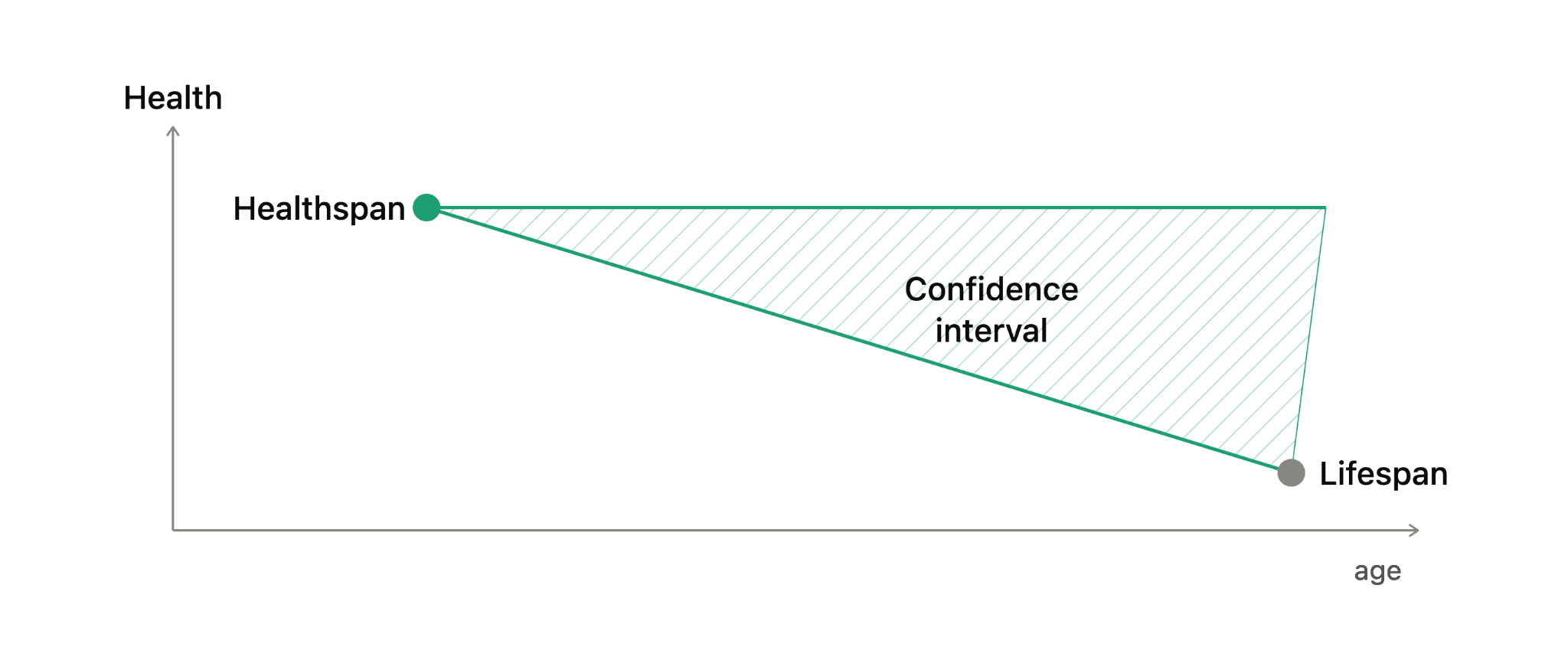
Lifespan tells us how long we remain alive. Healthspan tells us how long we remain capable of living well. The difference between those two numbers may be the single most meaningful measure of human health. It represents the years between the moment your body stops supporting the life you want to live and the moment life itself ends. It is measured in missed adventures, surrendered independence, declining resilience, and the gradual loss of choice. It is the day you stop trusting your body to carry you through your own life. I believe that space deserves a name, and it's called the Confidence Interval.
In statistics, confidence is built through evidence. In life, confidence is built through adaptation.
Originally used in statistics, a confidence interval represents the range within which the true value is expected to exist. As evidence accumulates, uncertainty decreases, the interval narrows, and confidence in the estimate grows. In statistics, narrowing the interval brings us closer to the truth. In life, narrowing our Confidence Interval brings us closer to living it. The parallel is intentional. In statistics, confidence is built through evidence. In life, confidence is built through adaptation.
I borrow that concept deliberately because it captures something profoundly important about health. None of us knows exactly how many years we will remain capable, independent, and fully engaged in life. That truth has yet to reveal itself. Unlike a statistical confidence interval, however, ours is not simply calculated. It is shaped. Every decision we make either widens it or narrows it. Be it every workout, meaningful adaptation, year of strength preserved or improvement in cardiorespiratory fitness. It's influenced by every habit repeated long enough to become part of who we are. We are not passive observers of our confidence interval. We are active participants in shaping it.
The analogy extends one step further. In statistics, a narrower interval reflects greater certainty about where the truth lies. In health, a narrower Confidence Interval reflects greater confidence that our bodies will continue meeting the demands of life. The goal is not simply to live longer. It is to compress the years between healthspan and lifespan until the distance between being alive and living well becomes as small as possible.
The power of this idea, however, lies less in the word interval than in the word confidence. Not statistical confidence. Human confidence. The confidence to trust your body. The confidence to sit on the floor without wondering whether you will stand again. The confidence to carry your own luggage, hike the mountain, chase your grandchildren, recover from illness, shovel the driveway, or simply continue saying yes to the opportunities that make life meaningful. Confidence is more than a personality trait. It is an expression of physiological reserve. It is the lived experience of capacity, and capacity is earned through adaptation. As our capacity grows, so does our confidence. As confidence grows, we participate more fully in life. Every adaptation strengthens the body, but it also expands the boundaries of the life we believe ourselves capable of living.
This is why the confidence interval is more than a metaphor. It is a framework for understanding health itself and it changes the question. Instead of asking only, "How long will I live?" we begin asking, "How much of that life will I remain fully capable of living?" Instead of measuring success solely through weight, blood pressure, cholesterol, or medications, we begin asking a different question. Did this behavior increase my capacity? Did it preserve my independence? We can look at every meaningful health decision filtered through that lens. And so every meaningful adaptation narrows the confidence interval.
Disease and decrepitude rarely arrive all at once. They emerge through the gradual loss of capacity, quietly eroding strength, resilience, and independence until the freedoms we once took for granted begin to disappear. That process does not begin when disease is diagnosed. It begins years, often decades, earlier when we stop demanding enough of our bodies to preserve the adaptations that keep us capable. The purpose of training, then, is not simply to extend life. It is to preserve the capacity to live it fully for as long as possible, narrowing the distance between healthspan and lifespan.
The Architecture of Independence
If the Confidence Interval is the distance between living and living well, then the question naturally becomes: How do we narrow it?
The answer is surprisingly simple. We build capacity.
CrossFit defined fitness as "increased work capacity across broad time and modal domains," and in doing so, redefined not just exercise but health itself. Hidden inside that deceptively simple sentence is a truth medicine is only beginning to appreciate: capacity is the foundation of independence. Every adaptation we earn becomes a reserve we can draw on later in life, and every improvement in strength, endurance, balance, coordination, power, flexibility, speed, accuracy, agility, and stamina expands what our bodies are capable of doing, not simply today, but decades from now. This is why the Sickness–Wellness–Fitness Continuum remains one of the most elegant models in health: it rejects the false notion that health is binary. We are not simply healthy or unhealthy. We move continuously along a spectrum shaped by our behaviors and our capacity to adapt, and every choice, workout, or behavior moves us somewhere along it. Fitness, then, was never the destination. It is the mechanism, the way we build the capacity that protects health, preserves independence, and ultimately expands freedom. As we move toward the fitness end of the continuum, we narrow our Confidence Interval. Seen through this lens, the ten physical skills of the CrossFit methodology are not simply components of fitness. They are the architecture of independence.
They represent the finite collection of physical capacities required to continue directing your own life. They determine whether you can rise from the floor after kneeling in the garden, carry your own luggage through an airport, catch yourself before a stumble becomes a fracture, climb the stairs without searching for a handrail, recover from illness instead of being defined by it, and continue participating in the experiences that give life meaning. None of these capacities exists in isolation because life never demands them individually. Every meaningful task requires them working together as one integrated system.
This may be one of CrossFit's greatest contributions to public health. CrossFit recognized that independence itself could be trained. The methodology was never designed to create elite athletes alone. It was designed to create resilient human beings. It understood that fitness was valuable not because it produced extraordinary performances inside the gym, but because it preserved the quality of life outside of it.
Modern science has spent the last two decades validating what the methodology proposed from the beginning. Cardiorespiratory fitness has emerged as one of the strongest predictors of all-cause mortality ever identified, exceeding many traditional cardiovascular risk factors in its predictive power (Lang, 2024). Muscle strength predicts resilience. Muscle power predicts survival even better than strength alone. Walking speed, balance, flexibility, grip strength, and even the simple ability to lower oneself to the floor and stand back up independently predict disability, institutionalization, quality of life, and longevity (Araújo et al., 2024; 2025a; 2025b; Leong et al., 2015; Sherrington et al., 2020). Scientists study these capacities one variable at a time because research demands isolation. Human life never does. Life asks us to express them simultaneously, and CrossFit has trained them that way from the very beginning.
Embracing this distinction is important because we are not training isolated muscles or individual physiological systems. We are constructing a body capable of meeting the unpredictable demands of life. Capacity is cumulative. Improvements in strength reinforce balance. Better balance protects power. Greater cardiovascular fitness enhances recovery. Mobility allows strength to be expressed. Coordination organizes each system into efficient movement. Every adaptation amplifies the next until together they become something larger than fitness itself. They become physiological reserves.
Reserve is one of the most underappreciated concepts in health. It is the difference between surviving illness and recovering from it. It is the difference between stumbling and falling, between surgery and rehabilitation, between living independently and depending on someone else to perform the tasks that once defined daily life. Physiological reserve is the biological savings account from which we withdraw every time life presents an unexpected challenge. The larger that reserve becomes, the narrower our Confidence Interval becomes.
This is why training has never been about today's workout. We are training for tomorrow's diagnosis, next year's injury, the fall we hope never comes, the grandchildren we want to lift, the mountains we still hope to climb, and the decades that have not yet arrived. The strength you build in your forties becomes the independence you preserve in your seventies. The cardiovascular engine you develop today becomes the reserve that carries you through surgery, illness, and recovery tomorrow. Every adaptation you earn now becomes another layer of protection against the predictable effects of aging.
This reframes the purpose of fitness entirely. We are no longer exercising simply to improve performance, lose weight, or change our appearance. We are deliberately narrowing our Confidence Interval. Every meaningful adaptation ultimately increases our capacity and reduces the distance between healthspan and lifespan. Every workout expands the years our bodies remain capable of supporting the lives we want to live.
Death will eventually arrive for every one of us. Until then, our Confidence Interval remains remarkably malleable. It is shaped less by fate than by the cumulative adaptations we build across an entire lifetime. The architecture of independence is not built in a single workout, nor does it disappear overnight. It is constructed patiently, one deliberate repetition, one difficult decision, and one meaningful adaptation at a time. Every year spent building capacity is another year reclaimed from the interval between merely surviving and truly living.
The Flywheel: Confidence Is the Mechanism That Narrows the Interval
If the Confidence Interval measures the distance between living and living well, then understanding how it closes the healthspan–lifespan gap, becomes the next question. It doesn't narrow it through good intentions, better technology, or passive consumption. It becomes more precise through adaptation. Every meaningful demand placed on the body creates the capacity that allows us to keep saying yes to life.
But adaptation is not simply a physiological process. It is also a behavioral one. Muscles adapt. Hearts adapt. Bones adapt. Mitochondria adapt. So do beliefs, habits, and identity. The body and the mind are engaged in the same conversation, each continually shaping the other. This is why confidence occupies such a central role in health. Not because confidence feels good, but because confidence determines what we continue doing long enough for adaptation to occur.
The confidence that matters is not personality. It is not optimism, bravado, or positive thinking. It is earned confidence. It is the belief that your body will do what your mind asks of it because it has done so before. It is the confidence to lift the heavy box without hesitation, to kneel on the floor knowing you can stand again, to shovel the driveway after a snowstorm, to hike the trail without wondering whether you'll make it back, or to catch yourself before a stumble becomes a fall. Confidence is not only how we think about our bodies. It is how we experience the capacity we have built.
Capacity and confidence exist in a reciprocal relationship. Each adaptation strengthens both. As capacity grows, confidence expands. As confidence expands, we willingly expose ourselves to new challenges. Those challenges create new adaptations, which further increase capacity. The flywheel begins to turn. The reverse is equally true. When capacity declines, confidence quietly declines with it. We begin organizing our lives around what we no longer trust ourselves to do. We avoid the stairs. We stop carrying heavy objects. We hire someone to shovel the driveway. We choose the shorter walk, the easier route, the safer option. Eventually our world becomes smaller, not because life has changed, but because our confidence has.
This is why the Confidence Interval is far more than the gap between healthspan and lifespan. It is also a reflection of the confidence we carry into daily life. Adaptation strengthens the physiological reserve of our interval. At the same time, we're rewarded behaviorally by expanding the range of things we continue believing ourselves capable of doing. The same adaptation accomplishes both. It strengthens the body while reinforcing the belief that the body can still be trusted.
CrossFit recognized something that much of healthcare continues to overlook. Chronic disease is not simply a biological problem. It is the downstream expression of behaviors shaped by the environments in which people live. Diabetes, hypertension, cardiovascular disease, obesity, and many of the conditions that dominate modern medicine emerge over years of repeated choices, but those choices rarely occur in isolation. They are influenced by the food that surrounds us, the communities we belong to, the norms we adopt, the convenience we prioritize, and the environments that either demand adaptation or quietly eliminate it. Biology records what behavior rehearses, and behavior is largely a reflection of the environment. While genetics may influence risk, our daily habits and the worlds that shape them determine whether that risk is realized.
If disease develops where unhealthy behaviors become the default, then health is restored by creating environments where healthy behaviors become the default. That is precisely what the CrossFit affiliate provides. It is more than a place to exercise. It is an ecosystem intentionally designed to make adaptation normal, accountability expected, community unavoidable, and healthy behaviors repeatable. The affiliate changes the environment that shapes behavior, and in doing so, it becomes one of the most powerful interventions for strengthening the Confidence Interval.
That raises a more important question. Why do people actually change?
Behavioral science has spent decades unpacking this. The Transtheoretical Model describes change as a progression through precontemplation, contemplation, preparation, action, and maintenance. The model is familiar because nearly everyone has lived it. It is the same journey taken by the prospective member who first begins wondering whether life could be different, cautiously schedules an introductory session, survives the first workout, joins the affiliate, and years later cannot imagine living any other way. Sustainable health is rarely the result of a single decision. It is the accumulation of thousands of repeated decisions that eventually become identity. We know that knowledge alone is rarely enough to sustain those decisions and therefore the strongest predictor of long-term behavior is self-efficacy.
Albert Bandura defined self-efficacy as the belief that we are capable of successfully accomplishing the task before us. In many ways, it is simply another language for earned confidence. More importantly, Bandura identified how that confidence develops. It grows through mastery experiences, by doing difficult things successfully. It grows by watching people like ourselves succeed. It grows through encouragement from trusted mentors. It grows when discomfort is no longer interpreted as danger, but as evidence that adaptation is taking place. What's remarkable is that every one of these conditions already exists inside a CrossFit affiliate.
Members accumulate mastery experiences every single day. They lift weights they once believed impossible. They complete benchmark workouts faster than they thought they could. They perform their first pull-up, first rope climb, first muscle-up, or simply stand from the floor more easily than they did six months earlier. They watch people who look like them accomplish extraordinary things. Coaches provide immediate feedback, encouragement, and accountability. Elevated heart rates, burning lungs, and sore muscles gradually cease to represent fear and instead become familiar evidence that meaningful adaptation is occurring. Confidence is not taught inside the affiliate. It is manufactured through repeated success.
The affiliate is the engine that narrows the Confidence Interval. Every class turns the same flywheel. Members attempt something difficult. They discover they are capable. Success strengthens confidence. Confidence increases participation. Greater participation produces more adaptation. More adaptation builds greater capacity. Greater capacity further narrows the Confidence Interval, making the next challenge feel possible. The flywheel accelerates because every revolution reinforces the next.
In reality, two flywheels are turning simultaneously. The first is physiological. Stress. Adaptation. Recovery. Increased capacity. The second is behavioral. Action. Mastery. Confidence. Consistency. Neither can sustain health on its own. Physiological adaptation without continued participation eventually disappears. Motivation without increasing capacity eventually fades. Lasting health emerges only when both flywheels reinforce one another, creating a system in which biology and behavior become inseparable. This is precisely what makes the affiliate model so powerful. It does not merely improve fitness. It simultaneously changes the body and the beliefs that keep someone returning long enough for those physiological changes to compound over years and decades.
This is also where much of the modern wellness industry falls apart. Most wellness products promise outcomes while asking almost nothing of the person using them. Recovery devices recover nothing if meaningful work never precedes them. Wearables measure behavior but cannot create it. Supplements promise adaptation without demanding the stress that biology requires to produce it. They encourage consumption where human physiology requires participation. None of them can manufacture a mastery experience because none of them require a person to confront something difficult and discover they were capable all along. The consumer remains trapped in contemplation, endlessly purchasing the appearance of health without producing the adaptations that actually narrow the Confidence Interval. If adaptation is the mechanism that builds capacity, then avoiding it leaves us increasingly uncertain that our bodies will meet the demands of the future.
The irony is impossible to ignore. The effort modern culture has worked so hard to eliminate was never the price we paid for health. It was the mechanism that created it. Health is not something we consume our way into. It is something we repeatedly become capable of. That is the flywheel and every revolution narrows the Confidence Interval.
Health is not something we consume our way into. It is something we repeatedly become capable of.
The Lifeboat
The machinery that narrows the Confidence Interval cannot exist as an idea alone. It has to live inside a community. The physiological reserve that preserves independence and the behavioral momentum that sustains it require an environment intentionally designed to challenge people, support them, and invite them back tomorrow.
Greg Glassman famously described CrossFit affiliates as lifeboats in a tsunami of chronic disease. More than two decades later, that metaphor has become less poetic and more prophetic. While modern healthcare has largely organized itself around treating the consequences of chronic disease, and the wellness industry has built an economy around selling the appearance of health, the CrossFit affiliate has quietly continued producing something far more valuable. It produces adaptation. It produces confidence. It produces capability. It produces people who are increasingly able to care for themselves and, in doing so, increasingly capable of caring for one another.
That transformation extends well beyond physiology. Human beings have always adapted in communities. Behaviors spread through social networks and shared expectations become culture. We borrow confidence from people who have already done what we are learning to do, and over time their standards become our own. One of the most consistent findings in behavioral science is that the people we surround ourselves with profoundly influence the people we become (Latkin & Knowlton, 2015). The CrossFit affiliate was never simply preparing people for the next workout. It has always been preparing them for the decades that follow. Every adaptation strengthens the Confidence Interval until healthspan and lifespan become nearly indistinguishable. This is not simply a different model of fitness. It is a different model of health.
REFERENCES
Araújo, C. G. S., de Souza e Silva, C. G., Kunutsor, S. K., Franklin, B. A., Laukkanen, J. A., Myers, J., Fiatarone Singh, M. A., Franca, J. F., & Castro, C. L. B. (2024). Reduced body flexibility is associated with poor survival in middle-aged men and women: A prospective cohort study. Scandinavian Journal of Medicine & Science in Sports, 34(8), e14708.
Araújo, C. G. S., de Souza e Silva, C. G., Myers, J., Laukkanen, J. A., Ramos, P. S., & Ricardo, D. R. (2025a). Sitting-rising test scores predict natural and cardiovascular causes of death in middle-aged and older men and women. European Journal of Preventive Cardiology, zwaf325.
Araújo, C. G. S., Kunutsor, S. K., Eijsvogels, T. M. H., et al. (2025b). Muscle power versus strength as a predictor of mortality in middle-aged and older men and women. Mayo Clinic Proceedings.
Bandura, A. (1977). Self-efficacy: Toward a unifying theory of behavioral change. Psychological Review, 84(2), 191–215.
CrossFit, Inc. (2023). CrossFit Level 1 Training Guide. CrossFit, LLC.
Delbaere, K., Close, J. C. T., Heim, J., Sachdev, P. S., Brodaty, H., Slavin, M. J., & Lord, S. R. (2010). A multifactorial approach to understanding fall risk in older people. Journal of the American Geriatrics Society, 58(9), 1679–1685.
Dos'Santos, T., Thomas, C., Comfort, P., & Jones, P. A. (2019). Role of change-of-direction biomechanics in injury risk and performance. Sports Medicine, 49(3), 367–383.
Garmany, A., & Terzic, A. (2024). Global healthspan-lifespan gaps among 183 World Health Organization member states. JAMA Network Open, 7(12), e2450241.
Grøntved, A., et al. (2017). Muscle-strengthening activities and risk of all-cause mortality: A meta-analysis. JAMA Internal Medicine, 177(4), 534–543.
Hacker, K. (2024). The burden of chronic disease. Mayo Clinic Proceedings: Innovations, Quality & Outcomes, 8(1), 112–119.
Lang, J. J., Prince, S. A., Merucci, K., et al. (2024). Cardiorespiratory fitness is a strong and consistent predictor of morbidity and mortality among adults: An overview of meta-analyses representing over 20.9 million observations from 199 unique cohort studies. British Journal of Sports Medicine, 58(10), 556–566.
Latkin, C. A., & Knowlton, A. R. (2015). Social network assessments and interventions for health behavior change: A critical review. Behavioral Medicine, 41(3), 90–97.
Laukkanen, J. A., Lavie, C. J., Khan, H., Kurl, S., & Kunutsor, S. K. (2019). Cardiorespiratory fitness and the risk of serious ventricular arrhythmias: A prospective cohort study. Mayo Clinic Proceedings, 94(5), 833–841.
Leong, D. P., et al. (2015). Prognostic value of grip strength: Findings from the PURE study. The Lancet, 386(9990), 266–273.
Prochaska, J. O., & Velicer, W. F. (1997). The transtheoretical model of health behavior change. American Journal of Health Promotion, 12(1), 38–48.
Reid, K. F., & Fielding, R. A. (2012). Skeletal muscle power: A critical determinant of physical functioning in older adults. Exercise and Sport Sciences Reviews, 40(1), 4–12.
Resnicow, K., DiIorio, C., Soet, J. E., Borrelli, B., Hecht, J., & Ernst, D. (2002). Motivational interviewing in health promotion: It sounds like something is changing. Health Psychology, 21(5), 444–451.
Schmidt, R. A., & Lee, T. D. (2011). Motor control and learning: A behavioral emphasis (5th ed.). Human Kinetics.
Sherrington, C., Fairhall, N. J., Wallbank, G. K., et al. (2020). Exercise for preventing falls in older people living in the community. Cochrane Database of Systematic Reviews, CD012424.
© 2026 2Be-Human, LLC. All Rights Reserved
Have something to say? Email us at
Subscribe to our newsletter

Sign up with your email address to receive news and updates.
